Why a University Ceremony Makes Belonging Visible
University ceremonies make belonging visible when people take part, not just watch. Learn how to choose rituals that connect campus values with shared action.
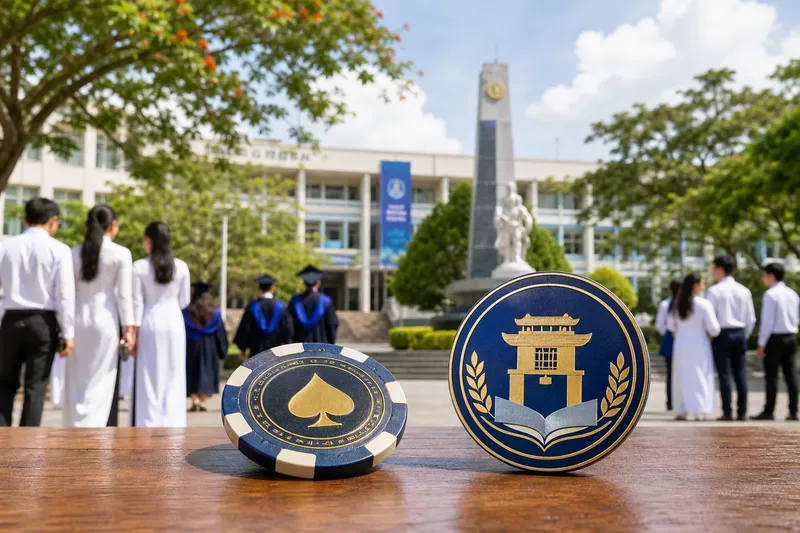
At Đại học Văn Hiến, a graduate adjusts a borrowed gown while a family member searches the auditorium for a seat. A university ceremony can make belonging visible in moments like these—but only if people have a meaningful way to take part. The central question is not whether the program looks formal; it is whether its actions help people recognize themselves as members of a shared institution.
Ritual gives public form to values that are otherwise easy to leave abstract. A welcome, a procession, a pledge, or a moment of recognition can express care, continuity, or collective responsibility. Yet symbols alone do not create that meaning. Participants have to understand what they are doing and have room to do it sincerely.
What ritual makes visible
A ceremony differs from an ordinary campus gathering because its repeated actions carry a public meaning. People may stand together, listen to a name, receive an object, or mark a transition. The sequence tells them that the moment matters to the institution as well as to the individuals involved.
For a university, that public character matters. A commencement recognizes a student’s work, but it also shows families, faculty, and peers how the institution acknowledges learning. A new-student welcome can signal that membership begins with an invitation, not merely with enrollment paperwork.
Repetition can make a ritual legible across generations. Participants need not interpret every detail in the same way, but they should be able to grasp why the action is there. If a procession has no connection to the occasion, or a pledge is recited without explanation, formal appearance can outlast shared understanding.
Three approaches to participation
Universities can shape ceremonies in different ways. The right approach depends on the occasion, the people in the room, and the value the institution wants the ritual to express. These options are not mutually exclusive, but each asks something different of participants.
Watching a formal ceremony
In a formal, primarily observed ceremony, a small group performs the central actions while the audience witnesses them. This approach suits occasions that need a clear sequence, such as awarding degrees or recognizing an institutional milestone. It can create a shared point of attention, though the audience may feel like visitors if the program leaves no place for their response.
Even a largely observed event can invite participation through a welcome spoken to the whole room, an accessible way to follow the program, or a closing gesture that includes graduates and guests. The aim is not to make everyone perform. It is to ensure that witnessing feels like a recognized role rather than passive attendance.
Joining a shared action
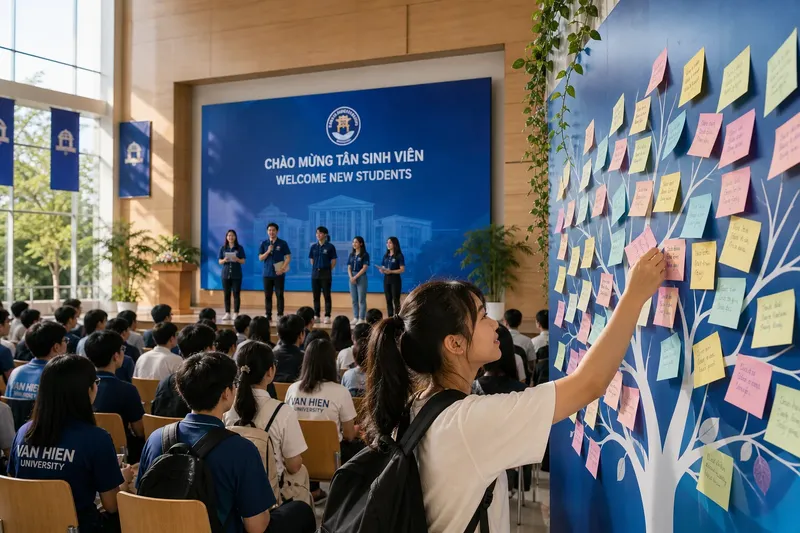
Here, the people present take part in a common gesture: singing, responding to a prompt, adding a written intention to a display, or collectively welcoming new students. This approach suits occasions centered on community and transition. It works best when the action is understandable, voluntary where appropriate, and feasible for people with different languages, mobility needs, or comfort with public speaking.
Participation should not be confused with forced uniformity. A person may belong without singing or speaking aloud. An alternative way to join—listening, signing, or contributing privately—can preserve the shared purpose without making one form of expression a test of membership.
Making a tradition together
A more collaborative approach invites students, staff, faculty, and community members to shape a ritual or contribute to its recurring form. It suits universities seeking a tradition with local meaning rather than a borrowed script. Shared design can make a ceremony feel connected to campus life, though participants need a clear account of what will recur and how suggestions will be considered.
Collaboration does not require every detail to be renegotiated each year. A stable core gives people something recognizable to return to; room for adaptation lets the ritual respond to changing communities. The balance is more persuasive than either a rigid script or an event that has no continuity.
Choosing a form that fits
Start with the value the ceremony is meant to express, then ask what participants should be able to do. If the purpose is recognition, a clear sequence for naming and honoring people may matter most. If it is welcome, an action that gives newcomers a visible place in the room may be more fitting than a long address about community.
Consider who can participate and who might be left at the edge. The event’s language, physical setting, timing, and expectations can affect whether people understand their role. A ceremony does not have to please everyone in every detail, but organizers should be able to explain why its central actions belong to this occasion.
- Match action to purpose: Name the value the ritual is meant to express, then remove gestures that do not help make it visible.
- Explain the sequence: Tell participants what will happen and why, especially when a tradition is unfamiliar to them.
- Make roles clear: Distinguish between those leading, those being recognized, and those witnessing, while giving each role dignity.
- Offer meaningful access: Consider language, mobility, sensory needs, and alternatives to speaking or standing together.
- Invite reflection afterward: Give participants a way to say what felt meaningful or confusing, then decide what should change and what should remain.
Say a planning group at Đại học Văn Hiến wants its new-student welcome to express that students become part of a wider academic community. Imagine organizers replace a string of unexplained speeches with a brief welcome from current students, followed by an invitation for newcomers to add a note about what they hope to contribute. The expected observable result is that new students have a defined action in the program and a visible record of their participation, rather than only an audience seat.
That choice also reveals a useful distinction: a ceremony should not ask an action to carry more meaning than participants can reasonably recognize. If the notes are displayed, the organizers should explain what happens to them afterward. Without that follow-through, the gesture may feel decorative rather than connected to a continuing community.
Where meaning can thin
A ritual can lose force when people are expected to repeat words they do not understand, or when a ceremony presents one way of belonging as the only legitimate one. Some participants may value formal language and inherited customs; others may connect more strongly to a direct welcome or a shared act of service. The institution can honor continuity without treating every tradition as beyond question.
Another risk is making participation purely visual. Matching clothing, banners, and a carefully arranged stage can establish a formal setting, but appearance cannot substitute for an intelligible role. If attendees cannot tell why they are there or what the ritual acknowledges, adding more symbols is unlikely to resolve the problem.
Reflection helps distinguish a living tradition from habit. After a ceremony, organizers can ask whether participants understood the central action, whether anyone felt excluded by its form, and which parts people would want to carry forward. These questions do not require turning every event into a survey; a short conversation with students and staff may be enough to identify a practical adjustment.
Questions about university ceremonies?
What makes a university ceremony meaningful?
Its actions connect the occasion to a value participants can recognize, such as welcome, learning, or recognition. Clear context and a genuine role for those present matter more than elaborate staging.
Do all attendees need an active role?
No. Witnessing can be a meaningful role when the ceremony acknowledges the audience and helps them understand what they are witnessing. Shared participation can take different forms, and it should not become a test of belonging.
How can a new campus tradition begin?
Choose a repeated action tied to a real campus purpose, explain why it matters, and invite the people affected to shape it. Keep the core recognizable while allowing the form to reflect the community’s changing needs.
When should a ceremony change?
Consider change when participants cannot explain the ritual’s purpose, when its format excludes people unnecessarily, or when its actions no longer fit the occasion. Preserve elements people value, but be willing to revise those that have become empty routine.
Belonging through action
A university ceremony makes belonging visible when people can recognize both the institution’s invitation and their own place within it. The strongest choice may be a formal presentation, a collective gesture, or a tradition shaped with participants; the decision should follow the purpose, not a preference for spectacle or novelty.
When reviewing a ceremony at Đại học Văn Hiến, ask one final, practical question: after the room empties, what will participants be able to say they did together? If the answer is clear, the ritual has offered more than a memorable image. It has given the community an action it can understand, repeat, and reconsider as campus life changes.