A Quiet Archive Visit for Reading University and Casino Images
A quiet archive visit for reading university and casino images helps you compare what captions emphasize, omit, and ask viewers to remember.
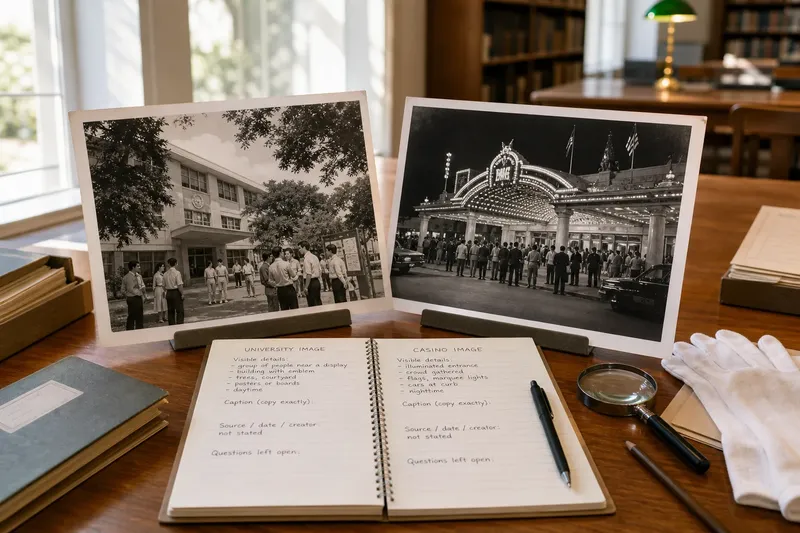
Where can you begin if you want to read university and casino images without turning either place into a metaphor for the other? A quiet archive visit needs only two images, a page for notes, and enough time to notice what their captions say—and what they leave unsaid.
Choose one image associated with Đại học Văn Hiến and one associated with a casino, from a printed collection or a credible online archive. Keep the comparison modest: describe what each image makes visible, then read the captions as acts of framing rather than as neutral labels.
Choose two images
Start with an image whose source and basic context can be identified. A university archive, library collection, museum catalog, or the institution’s own history pages may offer campus photographs, event scenes, or portraits. For the casino image, look to a museum or historical collection, an archive, or a clearly identified institutional source.
Try to select images that are legible but not necessarily dramatic. A campus courtyard, a room prepared for an event, a casino entrance, or a table scene can all prompt careful looking. The point is not to find matching compositions; it is to put two different kinds of public representation beside each other.
Before taking notes, record the title or caption exactly as presented, the source, and any date or creator the record supplies. If details are missing, write “not stated” rather than filling gaps with a guess. A saved page link or a catalog reference will help you return to the image later.
Read the visible details
Give each image a first pass without interpreting it. Note the people, objects, signs, architecture, and arrangement that are plainly visible. If the scene is crowded, describe where attention gathers; if it is empty, note what remains in view.
Then separate observation from inference. “A group stands near a doorway” describes what can be seen; “students are welcoming visitors” assigns a purpose that may not be established by the image alone. That distinction keeps the notes honest, especially when a photograph offers no explanation of who is present or why.
Look at the edges as well as the center. A cropped banner, an unreadable sign, a doorway beyond the main group, or the absence of people may matter—not as proof of a hidden story, but as a reminder that every frame has limits.
- List visible people or say that none are identifiable.
- Describe the setting without assigning a purpose to it.
- Write down any readable signs, emblems, or labels.
- Notice what appears at the margins or is cut off.
- Mark uncertain details as uncertain.
Compare the captions
Once the visual notes are separate, turn to the captions. A caption can identify a place, name a group, mark an occasion, or direct attention toward an institution’s preferred story. It may also be sparse, leaving the viewer to supply context.
Underline the nouns and verbs that carry the caption’s account. Does it name people as students, visitors, staff, guests, or simply a crowd? Does it describe an event, a room, or an institution’s achievement? These choices make some relationships easier to see than others.
Now compare the captions rather than the places. Ask what each caption makes central, what kind of audience it seems to address, and what information it does not provide. A university caption might foreground learning or community; a casino caption might emphasize hospitality, architecture, entertainment, or a particular moment. Those are possibilities to check against the actual wording, not assumptions to bring in beforehand.
Keep a short two-column note. On one side, copy the university caption; on the other, copy the casino caption. Beneath each, write one sentence about what the wording invites a reader to notice and one question it leaves open.
Keep the comparison bounded
It is tempting to treat the two images as evidence about the institutions themselves. Resist that leap. A photograph and its caption show a selected view, not the full routine, history, or social meaning of the place.
Instead, compare the work the captions perform. A record may present a scene as ordinary, ceremonial, welcoming, prestigious, or memorable. The question is not whether a university and a casino are alike; it is how each image and caption shape a viewer’s first impression.
Say you find a university photograph showing a hall with several people near a display, while a casino archive image shows a decorated entrance. Imagine the university caption names a student gathering, while the casino caption identifies an opening event. You could note that the first wording directs attention to a group’s activity and the second to an occasion, while leaving open who selected the images and what happened outside the frame.
This method also helps when captions are uneven. One record may offer a date, names, and an event description; another may provide only a broad title. Treat that difference as part of the archival encounter, but do not mistake missing information for evidence of a particular intention.
What should you write down?
How do I choose a useful image?
Choose an image with enough visible detail to describe and a source you can identify. A simple scene with a clear caption often offers more to read than a striking image whose context is entirely unknown.
What if the caption is very short?
Copy it exactly and note what it does not identify, such as the people, event, or date. Do not expand a brief caption into a story unless another part of the archive record supports that context.
Should the images show similar scenes?
They do not need to match in subject or composition. Since the task is to compare captions and framing, a campus gathering and a casino entrance can sit side by side without implying that the places serve the same purpose.
Can I use online images?
Yes, if the page identifies the image or collection clearly enough for you to cite it in your notes. Keep the source link and any displayed credit, and follow the archive’s terms if you plan to reproduce or share the image.
Close with a question
Before putting the notes away, write one question each image cannot answer on its own. Perhaps the university record leaves the participants’ roles unclear, while the casino caption does not say who organized the event. A good question marks the boundary between what the archive shows and what a reader would need to seek elsewhere.
For a quiet archive visit, two images are enough to practice that boundary. Keep the university image and the casino image distinct, and let the captions reveal their different choices of emphasis. The most useful note may be the one that says precisely what remains unknown.